







SPC training
Very engaged and focused throughout the course. Sticking to the agenda. Nice and pleasant.
Vegard Løkken
Production Manager, Nammo
The best Black Belts I know learned the methodology by using it — on a real problem, with close support along the way.
If you are ready to start now, I offer an individual programme tailored to you and your organisation. You work on your own improvement project and learn relevant methods with individual coaching, access to online courses and analytical support along the way. Same content as the classroom course — but at your own pace and on your own processes.
Would you rather wait for a group course? Join the waitlist.
This is for you if you:
Black Belt is particularly well suited for engineers, quality professionals and project managers in manufacturing companies with high demands for precision and process understanding.
Black Belt as an individual programme — tailored to you, your project and your organisation.
Step 1 — Preparation: You start with the online course «Facilitating Problem Solving in Teams» and select an improvement project. We meet to develop a Thought Map and put together a plan.
Step 2 — Implementation: You work on the project and learn methods where they are relevant — with coaching sessions, analytical support and access to online courses in SPC, MSA and hypothesis testing. We cover DOE, Factor Relationship Diagrams and Components of Variation — integrated into the project or as separate sessions.
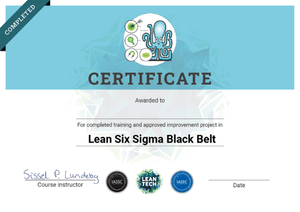
Step 3 — Certification: You present the project and results. Upon approved completion you receive a Lean Six Sigma Black Belt certificate.
Would you rather wait for a group course with classroom days? Join the waitlist.
MSc in Chemical Engineering • practising Six Sigma since 2002 • IASSC accredited instructor • completed multiple Black Belt projects and certifications.
I completed my first Black Belt through individual training at Sigma Science, led by Bill Ross — one of the pioneers of Six Sigma with over 40 years of experience applying statistical thinking and scientific method to uncover cause-and-effect relationships in processes and products.
This approach shapes my teaching, as summarised by Doug Sanders at Sigma Science:
«More often than not, it is not the formula, equipment, or roadmap that leads to the solution; it is the questions that are asked.»
Through my time as Operational Excellence Manager and collaboration with GoLeanSixSigma, I have expanded my competence in leadership, coaching and delivering results.
«Sissel is vibrant, engaging, highly competent and has a rare ability to make complex things simple and understandable. I wholeheartedly recommend her support on the journey towards Operational Excellence!»
Merete Mørk Mathisen, Operational Excellence Manager
Step 1 — Preparation
Step 2 — Implementation with individual support
Step 3 — Leadership, coaching and continuous improvement
Step 4 — Approval and certification
Duration: Normally 6–12 months, depending on the scope and complexity of the project.
DMAIC — Leading complex improvement projects
Understanding variation — SPC and sampling
Measurement System Analysis and variation source analysis
Design of Experiments (DOE) and Factor Relationship Diagram
Leadership, coaching and delivering results.
Included:
What are the requirements to start Black Belt?
You must have completed Green Belt with a course certificate. A completed Green Belt project is not required, but you should have a basic understanding of DMAIC.
What is the difference between Black Belt and Green Belt?
Green Belt teaches you to lead improvement projects. Black Belt goes deeper — you learn to handle complex problems involving multiple departments, understand variation and apply advanced analytical methods. You also learn to coach and support Green and Yellow Belts, and to assist management in project selection and benefits realisation.
What is the difference between Lean Tech Black Belt and GLSS Black Belt?
GLSS Black Belt is an English online course covering the full DMAIC methodology and project portfolio management. Lean Tech Black Belt has a stronger focus on practical statistics and understanding variation — particularly SPC as a discovery tool, MSA, Components of Variation and DOE with Factor Relationship Diagrams. Lean Tech Black Belt is particularly well suited for organisations with complex production processes where variation is a central challenge. The two courses are complementary.
How long does it take to complete Black Belt?
Normally 6–12 months, depending on the scope and complexity of the project. You set your own pace, but we establish milestones along the way to ensure progress.
What kind of project should I choose?
Choose a problem that is real and important to your organisation — ideally related to quality, variation, lead time or cost. The project should be complex enough to require statistical analysis, but realistic to complete within 12 months. We go through the project selection together in the first online session.
What is included in the price?
Individual coaching sessions, analytical support on your own project, access to online courses (Facilitating Problem Solving, SPC, MSA and hypothesis testing), course documentation and templates, and a Lean Six Sigma Black Belt certificate upon approved project.
Can I take Black Belt even if I don't work in manufacturing?
The course is primarily developed for organisations with complex processes where variation is a central challenge — typically manufacturing and process industry. Feel free to get in touch for a no-obligation conversation about whether the course suits your situation.
Get in touch for a no-obligation conversation about how an individual Black Belt programme can work for you and your organisation.
Would you rather wait for a group course? Join the waitlist.
Very engaged and focused throughout the course. Sticking to the agenda. Nice and pleasant.
Lean Tech AS | Kristoffer Robins vei 13
0047 481 23 070
Oslo, Norway
L - Look for solutions
E – Enthusiastic
A – Analytical
N - Never give up


