





SPC training
Very engaged and focused throughout the course. Sticking to the agenda. Nice and pleasant.
Vegard Løkken
Production Manager, Nammo
You learn how to use Design of Experiments to develop products and processes efficiently — reducing development costs and time.
Proper design and analysis helps you determine optimal solutions for your product, process or service.
Format: 1 day classroom with hands-on exercises. The course is scheduled based on interest.
This course is for you if you:
This course suits engineers, quality professionals and others working with product and process development, in any industry.
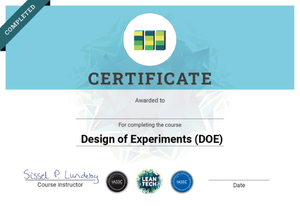
Course certificate upon completion.
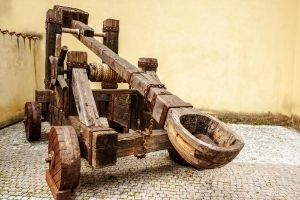
1 day classroom: A mix of theory and hands-on exercises where you design your own experiments, collect data and analyse the results. We use a Galton board and catapult for practical exercises.
Analysis tool: We use Minitab during the course, unless otherwise agreed. SigmaXL and JMP are alternative tools. A free 30-day trial version of the software can be downloaded before the course.
In-house training: We tailor content and format to your needs and challenges.
Introduction to Design of Experiments (DOE)
What is DOE and when do you use it? Overview of the approach and step-by-step implementation.
Step-by-step implementation:
Full factorial and fractional factorial
Nomenclature, number of runs and trade-offs between different designs.
Randomisation, blocking and centre point
How to design robust experiments that handle noise variables.
Graphical and statistical analysis
Determine the effect of factors and interactions. Analyse results in Minitab.
Optimisation
Determine which factor values give the optimal result.
Hands-on exercises:
Included:
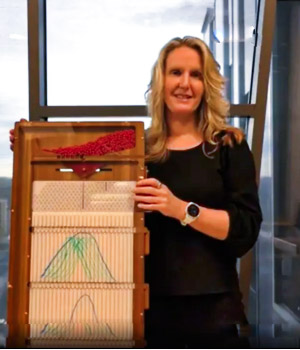
Galton board
The Galton board is used during the course to build a practical understanding of basic statistics and to run hands-on exercises.
Catapult
We build our own catapult and use it to run a full experimental design. We analyse the data and optimise the process based on the results.
Courses can be arranged on request and customized to your business needs.
Your own data can be used in examples and exercises.
Open courses are arranged according to the Course Calendar.
You can start e-learning when you want. You have access for a year and unlimited attempts to successfully complete multiple-choice exam.
Lunch, refreshments, and drinks during classroom training are included, and you receive a course completion certificate.
Course location varies; check "Place" in Course Calendar.
Lean Tech is located at Kristoffer Robins vei 13 (0978 Oslo) and organizes courses here.
We have an agreement with Thon Hotels and organize courses in other locations as needed.

Sissel Pedersen Lundeby is IASSC (International association for Six Sigma certification) accredited trainer associate:
"This accreditation publically reflects that you have met the standards established by IASSC such that those who participate in a training program led by you can expect to receive an acceptable level of knowledge..."
Sissel has a Master in Chemical Engineering and more than 20 years' experience within manufacturing and environmental technology. She has practiced Lean Six Sigma since 2002, completing Black Belt projects and certification through Cytec (2004) and IASSC (2017).
She use Lean Six Sigma to create measurable results and want her course participants to be successful improving their processes. That's why her training focus on practical application.
"Inspiring, professionally competent, popularize a theoretical discipline"
Espen Fjeld, Commercial Director at Berendsen
"Academic highly skilled and clear performance. Fun and builds trust"
Jon Sørensen, Production Manager at Berendsen
"10/10 good at reaching everyone"
Erlend Stene, Sales leader at Berendsen
"Clear and well presented. Good at asking questions and listen (check understanding)"
Morten Bodding, Production Manager at Berendsen
"Made a difference, engaged and skilled"
- Participant from EWOS
"You are inspiring, positive and professionally skilled"
- Participant from EWOS
"Clear presentations and well explained"
"I thought it was very rich, with good examples that made me reflect"
Do I need prior knowledge of statistics?
It is an advantage to have a basic understanding of statistics, but it is not a requirement. The course builds understanding step by step.
What is included in the price?
1 day classroom, course documentation and course certificate upon completion.
Which tool is used in the course?
We use Minitab during the course, unless otherwise agreed. SigmaXL and JMP are alternative tools. You can download a free 30-day trial version of Minitab before the course.
What is the connection between this course and Hypothesis Testing?
Hypothesis Testing teaches you to determine whether differences between datasets are statistically significant. Design of Experiments goes further and teaches you to plan and run structured experiments to find optimal settings. The two courses complement each other well — hypothesis testing is a central part of the analysis in DOE.
Is this relevant to my industry?
Yes. DOE is used in manufacturing, process industry, pharmaceuticals, food production and other industries where you want to optimise products or processes based on data.
Is the course delivered in English?
The course is normally delivered in Norwegian, but most Norwegian participants are comfortable attending in English. If you prefer English, please add a comment when you register. We will confirm with the other participants and get back to you — this is usually straightforward to arrange.
Very engaged and focused throughout the course. Sticking to the agenda. Nice and pleasant.
Lean Tech AS | Kristoffer Robins vei 13
0047 481 23 070
Oslo, Norway
L - Look for solutions
E – Enthusiastic
A – Analytical
N - Never give up


