



Course in Measurement System Analysis (MSA)
Are you making decisions based on measurements you can't trust?
Learn to assess whether your measurement system is good enough. Understand precision, accuracy, sensitivity and capability, and how to improve your measurements.
Format: E-learning (~ 1 hour) with certificate upon passing the quiz. Access for 1 year.
Interested in in-house training or support?
Who is this for?
This course is for you if you:
- Make decisions based on measurements, but are not sure whether you can trust them.
- Spend time discussing whether the numbers are right instead of acting on them.
- Chase process problems that may not exist, because the problem is in the measurement system.
- Are responsible for quality, laboratory analysis, or process improvement.
- Want to understand measurement system properties: precision, accuracy, sensitivity and capability.
"If you don't have good data, there'll be discussions around the table. If you have good data, you go straight to execution." — Aksel Lund Svindal
With good data you move from deviation to action. Without it, you move from deviation to discussion.

Includes certificate

What will you get out of this?
- Assess measurement system properties: precision, accuracy, stability, sensitivity and capability.
- Use control charts to carry out measurement system analyses.
- Design your own MSA studies and quantify variation.
- Understand variation and measurement uncertainty in your own measurement processes.
- Improve your measurement system before optimising the wrong thing.
- Certificate when you complete all videos and pass the quiz.
One customer saved 300 hours per year and increased productivity by 10–15% by replacing an unreliable measurement system.
It is an advantage to have completed the SPC course before taking MSA. Read more about the SPC course here.
What participants say
"Getting a grip on the concepts and methods cleared things up for me — it now feels more straightforward and easier to design an MSA."
Course participant, MSA course
"The course gave me new knowledge, especially in using control charts with subgroups. Good exercises with examples that are easy to relate to."
Course participant, MSA course
"Enthusiastic, engaging, highly competent, and with a talent for making complex things simple and easy to understand."
Merete Mørk Mathisen


How the course works
The course consists of 11 videos you complete at your own pace, with course documentation, exercises, and an Excel template for your own MSA studies. Access for 1 year.
- Introduction to MSA: What is MSA, and why do reliable measurements matter?
- Measurement system properties: Precision, accuracy, stability, sensitivity and capability.
- MSA with control charts: Assessing measurement system properties.
- Design and quantify: Planning your own MSA studies and quantifying variation with the Excel template.
- Improve the measurement system: Actions to improve precision and capability.
- Summary, documentation and MSA test.
Module 1: Introduction to MSA
- Introduction (1.5 min): Welcome to the course.
- Intro to MSA (3 min): What is MSA? Why do reliable measurements matter? What makes a good measurement?
Module 2: Measurement system properties (7 min)
- Precision: repeatability and reproducibility.
- Accuracy: bias and linearity.
- Stability, sensitivity and capability.
Module 3: MSA with control charts
- Introduction (1.5 min): How to use control charts to assess measurement system properties.
- Control charts with subgroups (5 min): Understand what control charts with subgroups tell you.
- Carrying out an MSA (8.5 min): Step-by-step guide to conducting a measurement system analysis.
Module 4: Designing an MSA (7 min)
How to design your own MSA studies based on your assumptions about sources of variation.
Module 5: Quantifying variation (13 min)
Use the Excel template to quantify process variation and measurement uncertainty. Calculate measurement system capability.
Module 6: Improving the measurement system
- Improving precision and visual inspections (2.5 min).
- Process map (4 min): Understand what drives variation in the measurement system.
Module 7: Summary (6 min)
Key takeaways and next steps.
Module 8: Resources
Course documentation, Excel template for MSA, and links to related resources.
MSA quiz
10 multiple-choice questions. Unlimited attempts. Pass and download your certificate.
What is measurement system analysis, and why do I need it?
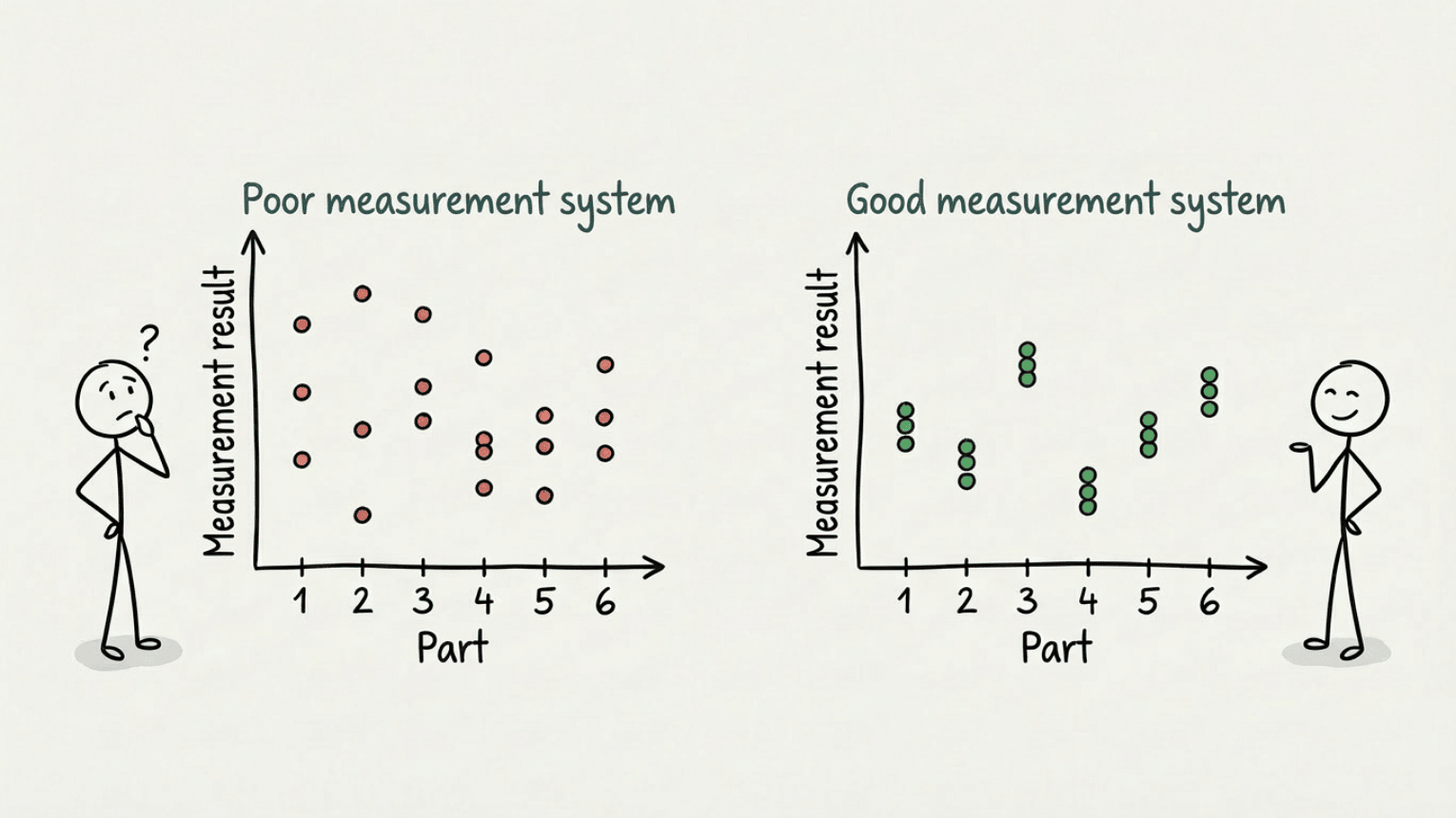
MSA evaluates the quality and reliability of a measurement system. The goal is to ensure that measurements are accurate, precise, stable over time, sensitive and capable enough to detect relevant differences. An unreliable measurement system can lead to poor decisions and unnecessary costs.
Do I need prior knowledge of statistics or Lean Six Sigma?
No. The course is designed for anyone who wants to assess measurement systems, regardless of background. We start with the fundamentals and build gradually with practical examples. It is an advantage to have completed the SPC course first, as MSA makes active use of control charts.
What is the difference between precision and accuracy?
Precision is about how consistent the results are when you measure the same thing multiple times. Accuracy is about how close you are to the true value. You can be precise without being accurate, and vice versa.
What is capability in a measurement system?
Capability is the measurement system's ability to detect differences in what is being measured. A common rule of thumb is that less than 10% of the observed variation should come from the measurement system for it to be considered adequate. If the measurement system contributes more than 30% of the variation, it is time to take action!
When should I carry out an MSA?
Before using data for important decisions, when introducing new measurement methods, when data varies unexpectedly, or when actions based on data are not delivering results. If your team is discussing whether the numbers are right instead of acting on them, it is a sign the measurement system should be reviewed.
How much time do I need to set aside?
The course takes approximately 1 hour in total. You can start whenever you like and work through the videos at your own pace. You have access for 1 year.
What is included in the price?
Access to all video modules (~1 hour), course documentation, Excel template for MSA studies, and a certificate upon passing the quiz. Access for 1 year from registration.
Will this work for my industry?
Yes. MSA applies to any industry where you work with measurement data, because the method is about variation in measurement systems, not specific products. Participants come from manufacturing, healthcare, food production, laboratories, the public sector, and more.
Do I receive a certificate?
Yes. You download your certificate once you have completed all videos and passed the quiz. The quiz has 10 multiple-choice questions and you have unlimited attempts.
These articles show why reliable measurements are essential for good decisions:
- The problem wasn't the process... — they ran 600 tests a year chasing process faults. The problem was the measurement system. Result: 300 hours saved and 10–15% productivity gain.
- Good data quality is essential for trust and improvement — on the difference between discussing whether a deviation is real and acting on it.
- Understanding measurement uncertainty for better decisions — 86% of the variation came from the measurement system, not the process.
Your instructor
Sissel P. Lundeby: 20+ years of MSA experience • IASSC-accredited instructor • MSc Chemical Engineering • Black Belt since 2002:
"Time and again, I see teams spending more time discussing whether the numbers are right than acting on them. Robust processes that consistently meet customer requirements depend on reliable measurements. MSA helps you find out whether your measurement system is good enough."

Interested in the MSA e-learning course in English?
The course is currently in development. Join the waitlist and be the first to know when it launches.
In the meantime,
Assignments
Contact info
Lean Tech AS | Kristoffer Robins vei 13
0047 481 23 070
Oslo, Norway
Lean
L - Look for solutions
E – Enthusiastic
A – Analytical
N - Never give up