


Lean Six Sigma Black Belt Course (GLSS)
Want to lead complex improvement projects across departments and coach others in continuous improvement? Black Belt gives you the analytical, statistical, and leadership skills you need.
Format: E-learning (~8 hours) incl. certification. Earns 8 PDUs (PMI).
Registration gives you full access to all courses and certifications from our partner GoLeanSixSigma for 1 year, at a total price of NOK 5,250. This includes Yellow, Green & Black Belt, Champion, and Lean.
Who is this for?
This course is for you if you:
- Need to lead complex improvement projects across departments and functions.
- Want to coach and mentor Green Belt and Yellow Belt resources in improvement work.
- Need deeper analytical and statistical skills to solve complex problems.
- Are responsible for driving improvement programmes and delivering lasting results.
- Want an internationally recognised advanced Lean Six Sigma certification.
Black Belt is often a full-time role in larger organisations. You act as an internal expert and drive strategic improvement projects.
"Well structured content; presented effectively with easy-to-use tools!"
Jim Nugent, Black Belt course participant

Includes certification
What will you get out of this?
- Strengthen your leadership skills to drive complex improvement projects.
- Lead cross-functional improvement projects using the DMAIC method.
- Carry out advanced statistical and data analysis.
- Coach Green Belt and Yellow Belt resources through project delivery.
- Lead improvement programmes and ensure lasting results.
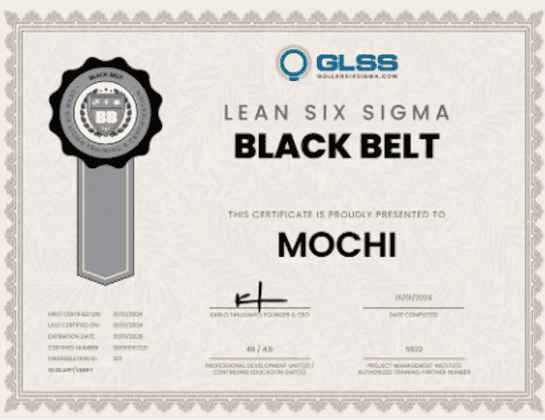
- Black Belt certificate when you complete the course and pass the knowledge test (valid for 2 years).
The course earns 8 PDUs (PMI) for project managers.
Want to build deeper competence in practical statistics and understanding variation? Lean Tech Black Belt is particularly well suited for complex manufacturing — with individual coaching on a real project.
What organisations say about GLSS
"GLSS does a great job explaining Lean Six Sigma in an easy to follow format — and that's not an easy task." — Scott Lamon, Continuous Improvement Manager, London Drugs
"With GLSS, we were applying the tools to a real project which solidified learning much better." — Eunjoo Greenhouse, Deputy Director, King County
"What enabled us to reach our goals was the accessibility and user-friendly design of the GLSS platform — its remote learning model, self-guided structure, and overall affordability." — David Welsh, Vice President of Operations, Radial
GLSS is trusted by Fortune 500 companies, government agencies, and over 3,000 universities worldwide.

How the course works
The course consists of 7 modules (~8 hours in total), completed at your own pace. You have access for 1 year.
- Module 1: Introduction — Overview and Ethical Efficiency.
- Module 2: Define phase — Generating project ideas, selecting value-adding projects, and risk assessment.
- Module 3: Measure phase — Data collection and measurement system analysis (MSA).
- Module 4: Analyse phase — Pareto, hypothesis testing, correlation, and regression.
- Module 5: Improve phase — Brainstorming, piloting, and Gantt charts.
- Module 6: Control phase — Quality mapping and RACI matrix.
- Module 7: Project portfolio — Leading and prioritising improvement programmes.
About GLSS and Ethical Efficiency
GLSS was founded by Karlo Tanjuakio with one vision: Lean Six Sigma that builds culture, not just fixes processes.
He calls it "Ethical Efficiency" — the balance between productivity and responsibility for people.
As he writes in his Forbes article:
"Let's not just do things right; let's do the right things."

Key topics
Leading complex improvement projects with advanced DMAIC
The course teaches you to lead and deliver advanced improvement projects using the DMAIC methodology:
- How to identify and prioritise the best improvement projects?
- How to lead the Define phase and ensure the project is correctly scoped from the start?
- How to collect reliable data and carry out a measurement system analysis (MSA)?
- How to use advanced analytical tools such as hypothesis testing and regression analysis?
- How to select, pilot, and implement solutions that stick?
- How to ensure lasting results and build a project portfolio?
- How to coach and mentor Green Belt and Yellow Belt resources?
Modules
Module overview
Module 1: Introduction (15 min)
- Overview of the Black Belt course.
- Ethical Efficiency.
Module 2: Define phase (60 min)
- Common challenges in the Define phase.
- Generating project ideas.
- Value-adding projects.
- Risk assessment.
Module 3: Measure phase (60 min)
- Common challenges in the Measure phase.
- Collecting data.
- Measurement system analysis (MSA).
Module 4: Analyse phase (90 min)
- Common challenges in the Analyse phase.
- Pareto.
- Hypothesis testing.
- Correlation and regression.
Module 5: Improve phase (45 min)
- Common challenges in the Improve phase.
- Brainstorming.
- Piloting.
- Gantt chart.
Module 6: Control phase (45 min)
- Common challenges in the Control phase.
- Quality mapping.
- RACI matrix.
Module 7: Project portfolio (45 min)
- Leading and prioritising improvement projects.
Certification
Certification
Certificate: You receive a Black Belt certificate when you have completed the course and passed the knowledge test.
Knowledge test: 120 multiple-choice questions. You must answer 80% correctly within 2 hours. Unlimited attempts.
Validity: The certificate is valid for 2 years. Recertification is done by retaking the course or completing a Lean Six Sigma project.
PDUs: The course earns 8 PDUs (PMI) for project managers.
Who is this course for?
Black Belt is for those who lead complex improvement projects across departments and want to coach others in improvement work. It is a natural next step after Green Belt.
Do I need prior knowledge of Lean or Six Sigma?
Green Belt or equivalent experience is recommended. Black Belt builds on the DMAIC methodology and introduces more advanced analytical tools.
How much time do I need to set aside?
The course takes approximately 8 hours in total and is completed at your own pace. You have access for 1 year.
What is included in the price?
Registration gives full access to all GLSS courses and certifications for 1 year. This includes Yellow, Green & Black Belt, Champion, and Lean.
What is the difference between Green Belt and Black Belt?
Green Belt teaches you to lead improvement projects within your own department or process. Black Belt goes further: you lead complex projects across departments, use more advanced statistical tools, and coach Green Belt and Yellow Belt resources. Black Belt is often a full-time role in larger organisations.
What is the difference between Black Belt (GLSS) and Lean Tech's own Black Belt course?
The GLSS Black Belt is a self-paced e-learning course of approximately 8 hours. Lean Tech's Black Belt course combines e-learning with online meetings and classroom sessions, and includes personal coaching while you complete a real improvement project in your own organisation.
How do I get certified?
You receive a Black Belt certificate when you have completed the course and passed the knowledge test. The test has 120 multiple-choice questions, and you must answer 80% correctly within 2 hours. You have unlimited attempts. The certificate is valid for 2 years.
Does the course earn PDUs?
Yes, the course earns 8 PDUs (PMI) for project managers.
What is a PDU?
PDU stands for Professional Development Units — credits required to maintain certifications from the Project Management Institute (PMI), one of the world's leading organisations for project management. If you hold a PMI certification such as PMP or CAPM, you must document ongoing professional development to keep it active. GLSS courses are approved as PDU-earning, meaning you can use them to meet this requirement.
Even if you do not hold a PMI certification today, PDU eligibility may be valuable if you plan to pursue one in the future.
Does this work for my industry?
Yes. DMAIC works regardless of industry because the method is about processes, not products. GLSS has participants from manufacturing, healthcare, finance, the public sector, and more.
Assignments
Contact info
Lean Tech AS | Kristoffer Robins vei 13
0047 481 23 070
Oslo, Norway
Lean
L - Look for solutions
E – Enthusiastic
A – Analytical
N - Never give up