






SPC training
Very engaged and focused throughout the course. Sticking to the agenda. Nice and pleasant.
Vegard Løkken
Production Manager, Nammo
We work with your team to find and solve root causes — not the symptoms that reappear next month.
Describe your problem in the Focus GPT. You will receive a structured summary. Send it to us, and we will give you a concrete diagnostic offer within 3 business days.
We work particularly well with manufacturing companies with complex processes, where cause-and-effect relationships are not obvious and several departments are involved.
Clients we have worked with over time have achieved capacity increases generating NOK 1.6 billion in additional revenue in one year, and a 28% reduction in waste valued at NOK 11 million.
"Sissel is energetic, engaging, highly competent and has an ability to explain things that makes complex topics simple and understandable. I wholeheartedly recommend her help on the path towards Operational Excellence."
Merete Mørk Mathisen, Operational Excellence Manager
"Your Lean Six Sigma workshops were exceptionally effective, offering actionable insights that drove immediate improvements. I highly recommend Lean Tech for your professionalism and expertise."
Cyrus Zareen, (former) President, Ekornes Beds AS
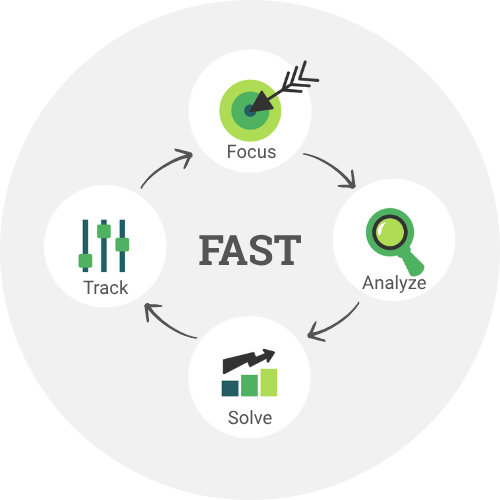
F — Focus: Agree on the problem before you try to solve it
"We all know what the problem is." That is the most dangerous assumption in team-based problem solving. We start by creating shared understanding of what is actually being measured, what the problem really is, and where in the cause-and-effect chain we are directing our attention.
A — Analyze: Separate signal from noise before you act
Most production managers are reacting to noise they believe is signal. Every deviation triggers an investigation. Every action makes the situation worse. We diagnose before we treat — and separate normal variation from special events that actually require action.
S — Solve: Fix the root cause. Once.
Most teams solve the symptom. It feels like progress. The numbers improve for a short period. Then the problem comes back. The principle is simple: if you have fixed it twice, you did not fix it the first time.
T — Track: Follow up so it lasts
A solution without follow-up is a hypothesis. You do not know if it worked until you measure it. And you do not know if it holds until time has passed. We build the measurement into the process so the improvement sustains itself.
Tools adapted to your needs
Depending on the problem, the engagement may include:
What sets this apart from other Lean Six Sigma offerings?
Most offerings teach you the method. We use the method to solve a real problem in your organisation. You apply it directly, with support along the way. That is the fastest path from problem to measurable results.
What kind of problems is this suited for?
The engagement suits challenges related to quality, delivery precision, throughput time, cost or process performance. We have experience from the chemical industry, food production, fish feed, furniture manufacturing, pharmaceuticals and the defence industry.
How many people should be involved from our side?
It depends on the problem. We typically work with teams of 4–8 people with the necessary knowledge of the process to be improved.
How is scope and duration determined?
We start with a conversation about the challenge and the need. Based on that we build a plan. Duration depends on the complexity of the problem.
Can we use our own data?
Yes. We always work with your own processes and your own data. That is the prerequisite for improvements that last.
Is this relevant for our industry?
The method is industry-neutral. It works particularly well for manufacturing companies with complex processes, where several departments are involved and cause-and-effect relationships are not immediately obvious.
Very engaged and focused throughout the course. Sticking to the agenda. Nice and pleasant.
Lean Tech AS | Kristoffer Robins vei 13
0047 481 23 070
Oslo, Norway
L - Look for solutions
E – Enthusiastic
A – Analytical
N - Never give up


