


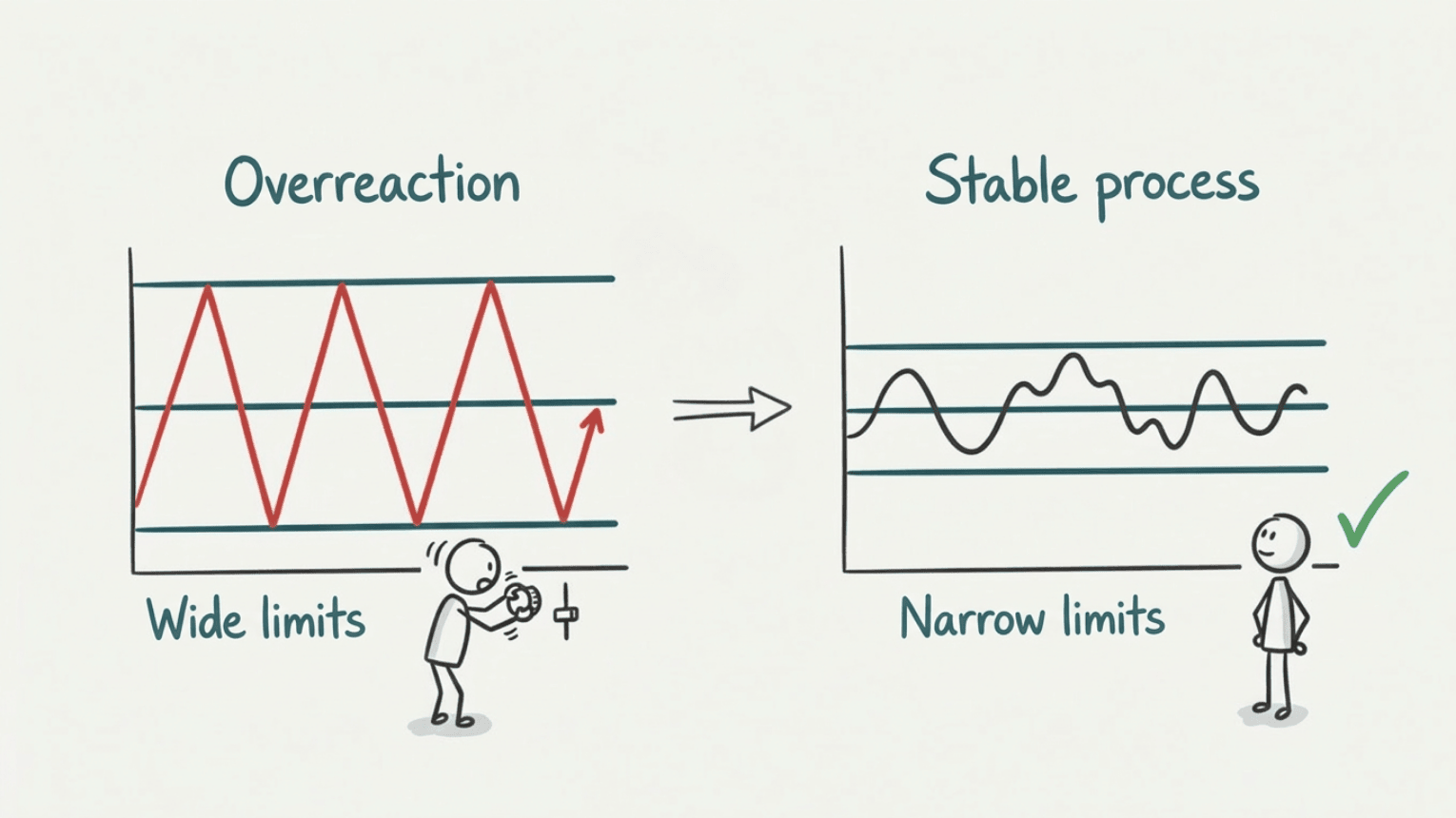
Are you Overreacting to Normal Variation?
The participants nodded at the examples. But the real learning happened when they tested it themselves and watched the variation increase with every adjustment.
I was running an SPC (Statistical Process Control) course for a client.
Not exactly the world's most exciting topic, right?
But it can save you time, money, and resources. If you use it correctly.
One key lesson:
Overreacting to common cause variation makes your processes worse.
Good intentions. Wrong reaction.
Like when:
- You ask the team to work faster because productivity was low yesterday.
- You change a setting because the previous shift had high defects.
- You switch suppliers because one delivery came late.
The participants nodded in agreement to the examples.
But the real learning happened when they tested it themselves and watched the variation increase with every adjustment.
In brief
Situation: SPC course with examples of overreaction to common cause variation.
Insight: Participants nodded at the examples, but only learned when they tested themselves and saw the variation increase.
Learning: Wrong actions make the problem worse. Without understanding variation, you're fighting ghosts.
Application: Applies to all types of improvement: production, administration, leadership, supplier management.
What this is about
The problem: We react the same way to everything, without knowing whether it's signal or noise.
Statistical process control (SPC) distinguishes common cause and special cause variation. Common cause variation is natural noise in the system. Special cause variation is a signal that something abnormal has happened.
Why it happens: Our brain is programmed to see patterns, even where none exist. We react to random fluctuations as if they're special events. The result? We adjust even when it's not the right action, and create more chaos.
Why it's critical: Both common cause and special cause variation can be problems that need solving. But they require completely different approaches:
- Special cause variation: Find and remove the specific cause that disrupted the process.
- Common cause variation: Improve the system and process, don't adjust random variables.
Without distinguishing between them, you risk choosing the wrong approach.
How to recognize it:
- Operators adjust every hour because "the number looks odd".
- Managers change tactics every week because "the previous one didn't work".
- Quality managers blame people instead of the system.
- The same problem keeps coming back despite multiple "solutions".
The problem isn't effort. It's that we can't tell signal from noise. So we react the same way to everything.
Everyday example: weight measurements
Say you weigh yourself every few weeks, and this time the scale shows 1 kg more.
Did you actually gain weight? Or is it just natural variation?
To find out, ask yourself:
- What is the measurement uncertainty of the scale?
- Were the measurements taken at the same time of day?
- Were you wearing the same clothes?
- Is 1 kg a real change, or within normal daily variation?
To find out, run a simple variation analysis. Weigh yourself daily for several weeks, taking multiple measurements each time. This lets you quantify how much the scale varies due to measurement uncertainty, time of day, and day-to-day differences.
Do you recognize this?
You might not weigh yourself daily, but you'll recognize this pattern:
- Test results vary, and you react immediately.
- You adjust the process based on one measurement, but nothing improves.
- The team discusses what's wrong after every small change.
- Two people measure the same thing and get different answers.
- You spend massive energy on "improvements" that actually make things worse.
When you don't distinguish noise from signal, you hunt for causes that don't exist and choose actions that don't work.
What you can use SPC for
Statistical process control uses control charts with control limits to separate common cause from special cause variation.
Here's what that gives you:
Determine robustness (capability): What is the common cause variation for the process, and how much margin do you have to customer requirements? Control charts show you whether the process is good enough to deliver what the customer wants.
Predictive maintenance: Wear can be detected in a control chart as special cause variation, for example through increased variation or trends. You can act before the machine fails.
Effect measurement of improvements: Special cause variation can be an early signal that the actions you've implemented are working. You know if the improvement works before months have passed.
Early warning: Work preventively by detecting tendencies toward deviations early, and implement actions before quality issues occur. Fire prevention instead of firefighting.
Ensure stable processes: A process with only common cause variation is predictable. If it simultaneously meets customer requirements, you have a robust and stable process.
What you can do in your organization
Step 1: Ask the right question
Next time you see a change in your measurements, ask: "Signal or noise?" Don't assume. Don't react immediately.
Step 2: Distinguish common cause and special cause variation
Common cause variation: The sum of all random factors in the process. To reduce it, you must improve the process's robustness (the system), not just adjust machines randomly.
Special cause variation: Identify and remove the specific cause that has disrupted the process.
Step 3: Know when to adjust (and when to do nothing)
Master this, and you'll stop:
- Wasting time on actions that don't work.
- Frustrating the team with constant changes.
- Using resources to "fix" problems that don't exist.
Instead, you use energy where it actually produces results.
Frequently asked questions
What's the difference between common cause and special cause variation?
Common cause variation is natural noise in the system: the sum of all small, random factors. Special cause variation is a signal that something abnormal has happened: you can look for a specific cause.
How do I know if I'm overreacting?
If you keep adjusting but the problem keeps coming back, or gets worse, you're reacting to common cause variation. Control charts help you see the difference.
What happens when I make random adjustments to common cause variation?
You increase the variation. Every unnecessary adjustment adds more chaos to the system. The result is more unstable processes and poorer quality.
When should I react to a change in measurement results?
When the measurement falls outside the control limits, or when you see clear patterns (trends, cycles). Then it's a signal, not noise.
Can I use SPC outside production?
Yes! SPC works on anything that can be measured over time: supplier performance, productivity, sales, customer satisfaction, work environment. Only your imagination sets the limits ;-)
Want to see this in action?
Watch our free video showing how to use control charts to quantify variation, starting with the weight example.
You'll learn:
- How control limits distinguish common cause from special cause variation.
- How to quantify measurement uncertainty, daily variation, and week-to-week variation.
- How you can use the method on your own measurements.
- When to react and when to leave it alone.
Watch free video about control charts
If you want to learn more about the topics in this post:
Assignments
Contact info
Lean Tech AS | Kristoffer Robins vei 13
0047 481 23 070
Oslo, Norway
Lean
L - Look for solutions
E – Enthusiastic
A – Analytical
N - Never give up